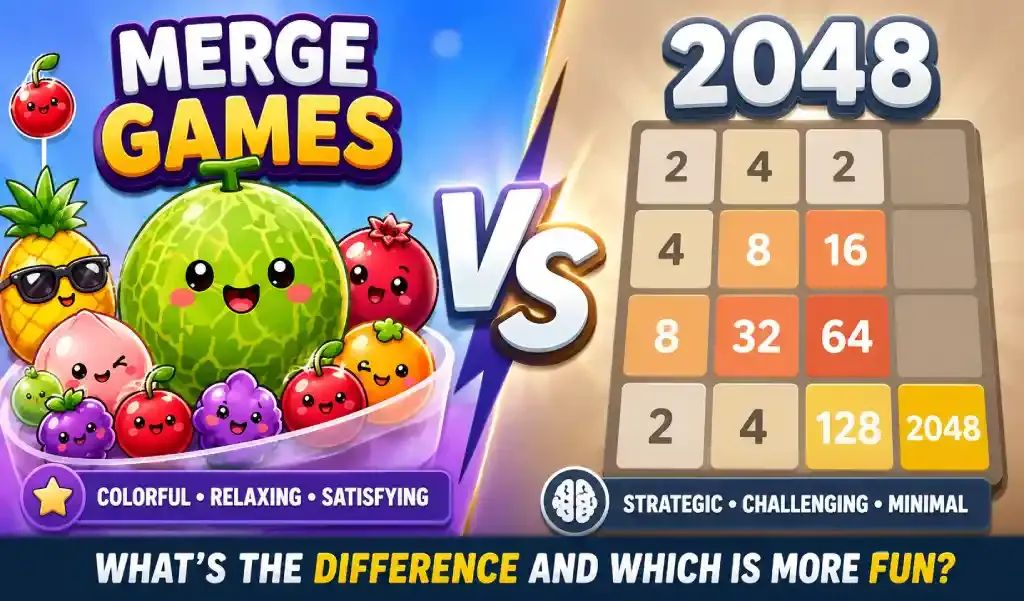
If you enjoy puzzle games that are easy to learn but difficult to master, you have probably come across both merge games and 2048. They may look similar at first because both involve combining numbers or objects to create something bigger, but the gameplay experience is quite different.
The main difference is simple: 2048 is primarily a number-based sliding puzzle, while merge games usually combine matching objects to create new ones. Merge games tend to be more visual and relaxing, while 2048 focuses more heavily on planning, positioning, and mathematical strategy.
So, which one is more fun? That depends on whether you prefer visual progression and satisfying combinations or a more strategic number puzzle.
What Is a Merge Game?
A merge game is a puzzle game where you combine two or more matching items to create a higher-level item.
For example, a fruit merge game might let you combine two small fruits to create a larger fruit. You continue merging objects as the board develops, with the goal of creating increasingly valuable items.
Many modern merge games use colorful objects, animations, sound effects, and simple controls. This makes them easy to understand even if you have never played a puzzle game before.
The basic gameplay loop is usually:
Match → Merge → Create → Repeat
The appeal comes from watching small objects turn into bigger ones while trying to manage limited space.
What Is 2048?
2048 is a number-based sliding puzzle in which you combine matching numbered tiles to reach the 2048 tile.
The classic game uses a 4×4 grid. When you swipe in one direction, the tiles move together. When two tiles with the same number meet, they merge into one tile with double the value.
For example:
2 + 2 = 4
4 + 4 = 8
8 + 8 = 16
The challenge increases because every move can change the entire board. One poorly planned swipe can leave you with fewer useful moves.
Unlike many merge games, 2048 is much more dependent on anticipating what will happen several moves ahead.
Merge Games vs. 2048: Key Differences
The biggest differences between merge games and 2048 come down to gameplay, visuals, strategy, controls, and progression.
| Feature | Merge Games | 2048 |
|---|---|---|
| Main mechanic | Combine matching objects | Combine matching numbers |
| Gameplay style | Visual and interactive | Strategic and grid-based |
| Controls | Usually tap, drag, or drop | Swipe |
| Visual appeal | Often colorful and animated | Usually minimalist |
| Strategy | Space management and merging | Positioning and move planning |
| Difficulty | Often gradual | Can become challenging quickly |
| Progression | New and larger objects | Higher-number tiles |
| Relaxation | Generally high | Moderate |
| Replayability | High | Very high |
Which Game Is Easier to Learn?
Merge games are generally easier to learn because their mechanics are more visual and intuitive.
A new player can usually understand a merge game after seeing just a few combinations. If two identical fruits or objects combine into a larger one, the result is immediately understandable.
2048 is also easy to learn, but mastering it is another matter. The basic swipe mechanic takes seconds to understand, yet successful play requires recognizing patterns and planning future moves.
This gives merge games a lower barrier to entry, particularly for casual players.
Which Game Requires More Strategy?
2048 generally requires more deliberate long-term planning than a typical merge game.
In 2048, where you place tiles matters enormously. Players often try to maintain a particular board structure and avoid filling critical spaces.
Merge games can also require strategy, especially when the playing area becomes crowded. You may need to decide whether to create a smaller merge now or wait for a better combination later.
The difference is that merge games often mix strategy with timing, spatial awareness, and visual decision-making, while 2048 places greater emphasis on numerical positioning.
Why Are Merge Games So Satisfying?
Merge games have a strong visual reward loop.
You place an object, combine matching items, and immediately see a new object appear. Larger combinations can trigger animations, sound effects, score increases, and other visual feedback.
That constant sense of progression is one reason merge games can feel satisfying even during short sessions.
For example, in a fruit merge game, watching several small fruits combine until you finally create a giant melon gives the player a clear goal without requiring complicated instructions.
This is especially appealing when you want a puzzle game that feels more relaxing than mentally demanding.
Why Is 2048 So Addictive?
2048 has a different kind of satisfaction.
The game rewards planning and problem-solving. Every successful combination feels like evidence that your previous moves were working.
There is also a strong "one more attempt" effect. You may lose after building a promising board and immediately want to try again because you believe you can make better decisions next time.
The simplicity is part of its strength. There are very few rules, but the number of possible board states creates a surprisingly deep puzzle.
Which Game Is Better for Short Sessions?
Both work well for short sessions, but merge games often feel more casual and accessible.
You can play a merge game for a few minutes, make several combinations, and stop without feeling like you need to complete a complicated strategy.
2048 is equally easy to start, but players often become focused on improving their score or reaching the next tile. A quick session can easily turn into multiple attempts.
If you want something visually relaxing during a short break, a merge game may be the better choice.
If you want a quick mental challenge, 2048 has the advantage.
Which Has Better Replay Value?
2048 has exceptionally strong replay value because every new game creates a different sequence of decisions.
Merge games can also be highly replayable because players want to discover larger combinations, achieve better scores, and improve their board management.
The two games simply motivate replay in different ways.
2048 encourages you to solve the puzzle better.
Merge games encourage you to progress further and create bigger combinations.
Which Is More Fun?
There is no universal winner because the two genres appeal to slightly different players.
Choose a merge game if you enjoy:
- Colorful graphics
- Fruit and object-based gameplay
- Satisfying animations
- Simple controls
- Relaxing puzzle sessions
- Creating increasingly larger items
- Casual gameplay
Choose 2048 if you enjoy:
- Number puzzles
- Strategic planning
- Minimalist gameplay
- Challenging decisions
- Improving your personal score
- Thinking several moves ahead
If you like visual games with a relaxing feel, merge games may be more fun. If you enjoy testing your logic and planning skills, 2048 may be more rewarding.
Merge Games vs. 2048: The Bottom Line
Merge games and 2048 share a basic idea—combine matching elements to create something larger—but they turn that idea into very different experiences.
2048 is a focused number puzzle built around sliding tiles and careful planning. Merge games are generally more visual, colorful, and progression-focused, with satisfying combinations and increasingly larger objects.
For pure strategic depth, 2048 is hard to beat. For casual entertainment, visual rewards, and relaxing gameplay, merge games have a strong advantage.
Ultimately, the better choice comes down to your mood. Want to think several moves ahead? Play 2048. Want to merge colorful objects and enjoy satisfying progression? Try a merge game.
And if you enjoy the second style, a fruit merge game such as Fruit Merge Melon Puzzle adds another layer of fun by turning simple matching mechanics into a race to create bigger and bigger fruits—all while trying to keep the board from filling up.