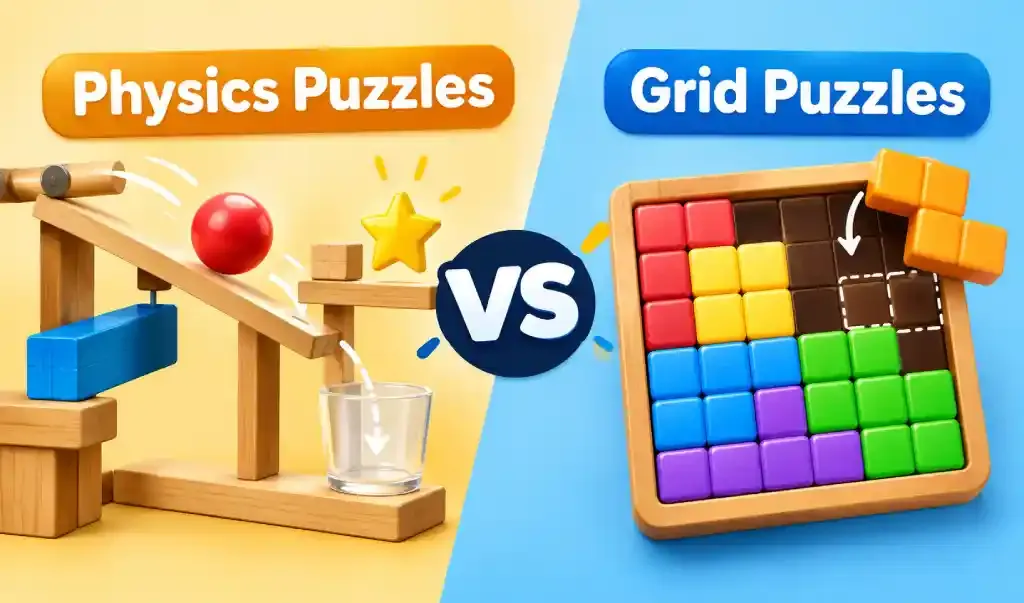
Grid puzzles (Tetris, 2048, match-3, Sudoku) run on fixed cells and predictable rules, so you can work out the correct move before you make it. Physics puzzles (merge games, Angry Birds, Cut the Rope) run on simulated gravity and collision, so you estimate instead of calculate. If you enjoy solving for the right answer, grid puzzles suit you. If you'd rather read a situation and improvise, physics puzzles will feel better in your hands.
Give two people the same thirty minutes and the same phone, and they will usually drift toward opposite kinds of puzzle. One wants a board that behaves. The other wants a board that surprises them.
Most "best puzzle game" lists ignore that split and just rank by download count. But it's the most useful thing to know about yourself before installing anything, because the two families reward completely different habits of mind.
The dividing line is simpler than it sounds
Here's a test that sorts almost any puzzle game in five seconds.
Could you play it on graph paper with a pencil?
Tetris, yes. 2048, yes. Sudoku, obviously. Candy Crush, yes, if you're patient. Every one of those lives on discrete cells. A piece is either in a square or it isn't.
Now try a merge game, where you drop fruit into a container and watch it roll, bump, and settle. You can't. You'd have to simulate gravity by hand, because where a piece lands depends on what it hit on the way down.
That's the whole distinction. Grid puzzles snap. Physics puzzles settle.
Side by side
| Grid puzzles | Physics puzzles | |
|---|---|---|
| Examples | Tetris, 2048, match-3, Sudoku, Threes | Merge games, Angry Birds, Cut the Rope, Peggle |
| Space | Fixed cells | Continuous |
| Outcome of a move | Predictable | Approximate |
| Same opening, same result? | Usually yes | Almost never |
| Core skill | Calculation, pattern recognition | Estimation, spatial prediction |
| How you improve | Learning strategies | Building feel |
| Typical failure | A move you can identify as wrong | A reasonable move that settled badly |
The real difference is how you lose
This is the part that decides which camp you'll enjoy, and nobody talks about it.
When you lose a grid puzzle, you can usually replay the mistake in your head. You stacked badly on the left. You merged the wrong pair three moves ago. The blame has a clear address, which is either satisfying or infuriating depending on your temperament.
When you lose a physics puzzle, it's murkier. You made a sensible drop, it clipped something, it rolled the wrong way, and your plan was gone. You weren't wrong exactly. You were unlucky, or your estimate was a few degrees off.
That ambiguity is why physics puzzles tend to feel more relaxing: the game absorbs some of the blame. Grid puzzles hand all of it back to you, which is why they feel like a test, and why some people find them far more compelling.
Neither is better. But if you've ever quit a puzzle game in irritation, that's worth knowing about yourself.
What each one actually asks of your brain
Grid puzzles lean on working memory and forward search. You hold the board in your head, run a few moves ahead, and pick the branch that doesn't trap you. Chess players tend to like these. So do people who enjoy spreadsheets, which is not an insult.
Physics puzzles lean on spatial prediction. You're guessing where a round object will end up after it hits two other round objects, which has more to do with having thrown things in real life than with arithmetic. People who are good at parking, pool, or packing a car boot usually take to these quickly.
Neither will measurably raise your IQ, whatever the app store descriptions claim. They're practice at slightly different kinds of thinking, and that's enough.
A quick way to tell which one you are
Which of these irritates you more?
- You lose because a piece bounced somewhere you didn't expect.
- You lose because you miscounted and trapped yourself four moves ago.
If it's the first, you want a grid. If it's the second, you want physics.
Another one: when a round ends, do you want to know the optimal play, or do you just want to go again? Optimal-play people are grid people. Go-again people are physics people.
Where the hybrids sit
Match-3 games like Candy Crush look physical because tiles fall into gaps, but the falling is cosmetic. The board is still cells and the cascade is deterministic. Grid.
Tetris has gravity in its theme, but a piece lands exactly where the rules say. Grid.
Merge and drop games in the suika family are genuinely physical. Drop the same fruit in the same column twice and you'll get two different boards. Physics.
Angry Birds and Peggle are physics with no grid anywhere near them.
So if you've only played match-3, you haven't tried both families. You've played two flavours of the same one.
Frequently asked questions
Is Tetris a physics puzzle? No. Despite the falling blocks, pieces snap to cells and land predictably. It's a grid puzzle.
Which type is more relaxing? Physics puzzles, usually, because losses feel less like personal error. Some people find unpredictability stressful and prefer the control of a grid.
Which is better for kids? Physics puzzles tend to suit young children, since they need no counting or planning ahead. Grid puzzles suit older kids who enjoy working things out.
Are merge games physics puzzles? Yes. Objects roll, collide, and settle in continuous space rather than snapping to a grid.
Can I like both? Plenty of people do. Grid puzzles for focus, physics puzzles for winding down.
The bottom line
Grid puzzles ask what the correct move is. Physics puzzles ask what you think will probably happen. Neither answer is smarter than the other, and the game you enjoy is simply the question you prefer being asked.
If you've mostly played grid puzzles and want to try the other side, Fruit Fall: Match Puzzle Game is a free, offline-friendly physics puzzle for iPhone and iPad. Drop fruit, let it settle, see what happens.