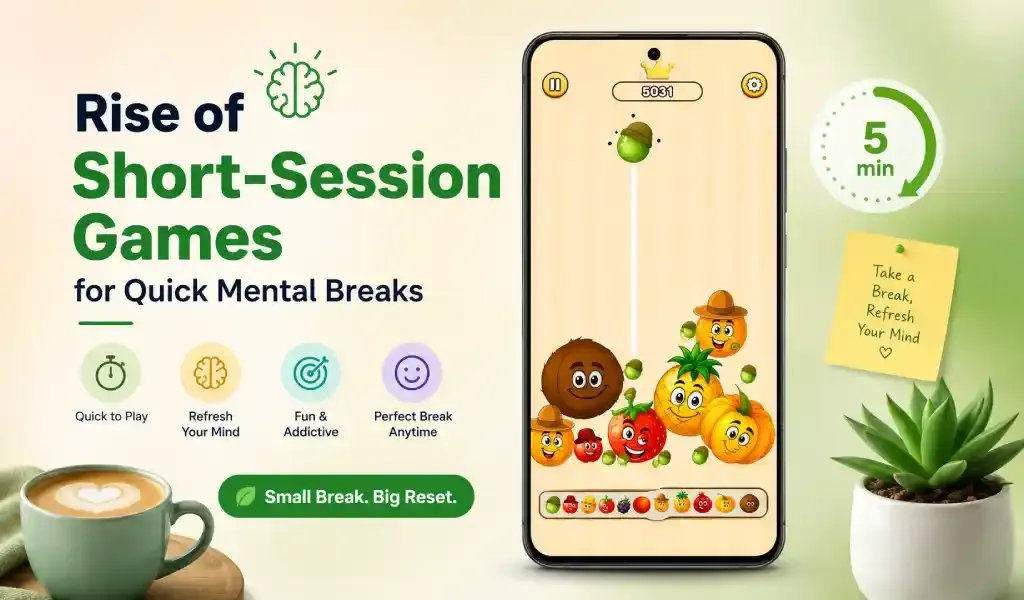
Short-session games are games built to be played for two to five minutes and put down without regret. They're growing because most of our free time comes in small gaps, not long blocks, and because a round with a clear ending gives the brain a cleaner break than an endless feed does. They work best when you treat them as a deliberate reset, with a timer, not a way to fill every spare second.
Think about when you actually pick up your phone. It's rarely a planned, free evening. It's the three minutes before a meeting starts, the queue at the pharmacy, the gap while the kettle boils. Those little pauses are where short-session games live, and they explain most of why the format has taken off.
What counts as a short-session game?
A short-session game is designed around the idea that you might stop at any moment. A few things tend to be true of it:
- A round takes a couple of minutes, not half an hour.
- There's nothing to lose by quitting. No lives that run out, no match you've abandoned on your team.
- The rules fit in a sentence. If you need a tutorial every time you open it, the game isn't short-session, whatever its round length.
- It has a built-in finish. The container fills, the board locks, the clock ends.
Drop-and-merge puzzles fit this almost perfectly. In Fruit Fall: Match Puzzle Game, for example, you drop fruit, match pairs into bigger ones, and the round ends when the stack reaches the top. You can play one round while waiting for a lift and be done before the doors open.
Why scrolling doesn't give you the break you wanted
Most people's default micro-break is the feed. It's right there, it takes no decision, and it feels like rest. But a feed never ends, and it keeps asking you to take in new information, which means your attention never gets a real pause. You put the phone down having consumed a lot and rested very little.
A short puzzle round is a different kind of break. You're doing one small, bounded thing. There's a result at the end, even if it's only a score, and then the activity is over. That ending matters more than it sounds: it's what lets you stop without feeling like you've been interrupted.
Why the format is growing
A few forces are pushing in the same direction.
Our days are chopped up
Between messages, notifications and back-to-back calls, long uninterrupted stretches are rare. A game that needs forty minutes of commitment just doesn't fit.
Phones are always in the pocket
The device is already there, so the cost of starting a game is close to zero. Games that load instantly and work offline win, because nothing stands between you and the first move.
People want a way out of the feed
Plenty of us are tired of the scroll and looking for a better default. A game with a natural end is an appealing alternative.
Developers have learned the format
Studios now build rounds, menus and onboarding around brief sessions, which makes the games feel better in short bursts than older, longer-form titles did.
What a good two-to-five-minute break looks like
You don't need an elaborate routine. Try this once or twice a day:
Pick the moment.
Right after finishing a task is ideal. You're closing one loop before opening another.
Set a timer for five minutes.
Not because five minutes is magic, but because a limit turns "just a quick go" into an actual plan.
Play one or two rounds, start to finish.
Finishing a round, even a bad one, gives your brain the sense of completion that scrolling never does.
Put the phone down and look at something far away.
Your eyes have been working too.
Go back to what you were doing.
If you feel pulled to play more, that's information. Sometimes you need a longer break. Sometimes you're avoiding the task.
When a short-session game is the wrong choice
Be honest about the limits.
- If you've been on screens all day, a walk or a stretch will do more for you than another screen.
- If you can't stop at one round, switch to something without a "one more" pull, or keep the timer strict.
- If you're using it to dodge something, the game isn't the problem, but it isn't solving it either.
- If it's late at night, screen light and stimulation can interfere with sleep. Keep sessions short, and finish well before bed.
How to choose a short-session game you won't resent
Look for these:
Instant start.
No long loading screens or log-ins.
Works offline,
So nothing buzzes at you mid-round.
No timer pressure.
Countdowns turn a break into a test.
Clear round endings,
So you know when you're done.
Ads you can live with.
Free games usually have them, and a full-screen ad after every round will eat the calm. Read recent reviews, and check whether there's an ad-free option.
If you want a starting point, we compare a few options in Top Rated Puzzle Games on App Store You Must Try.
Frequently asked questions
What is a short-session game? A game designed to be played in a few minutes at a time, with quick rounds, simple rules and no penalty for stopping. Casual puzzle games are the most common example.
How long should a quick mental break be? Two to five minutes is usually enough to change gear. If you're still wound up after that, a longer break away from screens is probably what you need.
Are short games better than social media for a break? Often, yes, because a round has a clear ending and asks for one small thing. A feed has no ending and keeps adding new input. That said, a walk beats both.
Can short-session games become a time sink? Yes. Any game with a "one more round" pull can. A timer and a rule that you finish rounds, not abandon them, helps.
What are the best short-session games on iPhone? Drop-and-merge puzzles, relaxed match games and simple word or number puzzles all fit. Fruit Fall: Match Puzzle Game is one example: free, offline-friendly and built around quick rounds.
Do short-session games help with stress? Small studies of casual games have found improvements in mood afterwards, but the evidence is limited. They're a sensible way to shift gears, not a treatment for anxiety or other conditions.
The bottom line
Short-session games are popular because they fit the way we really have time: in scraps. Used with a timer and a clear ending, they make a better reset than a feed. Used without limits, they're just another way to lose an afternoon.
We make Fruit Fall: Match Puzzle Game, so we're biased, but if you want to try a quick-round fruit puzzle, it's free on the App Store for iPhone and iPad.