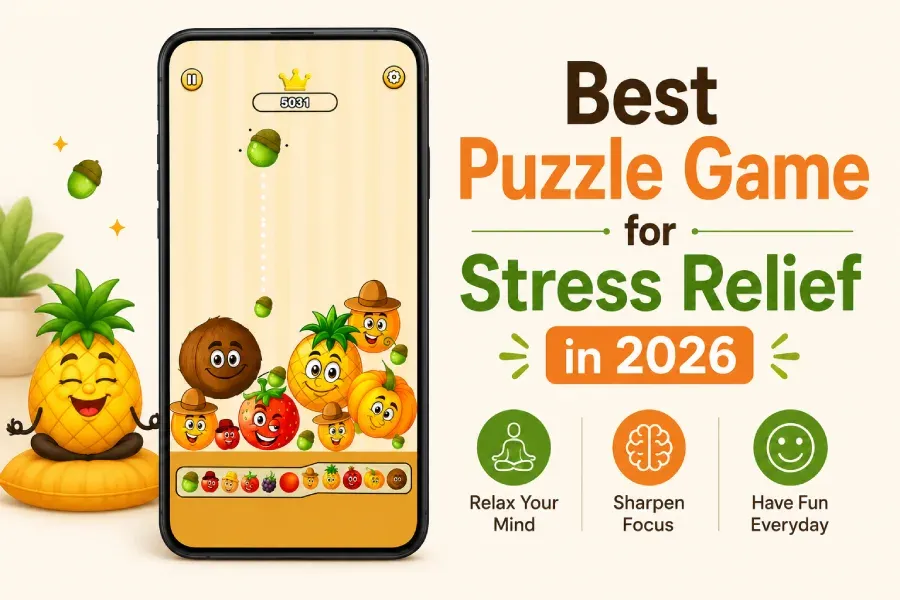
The best puzzle game for stress relief is one with no timer, simple controls, short rounds, soft visuals and sound, and few interruptions. Drop-and-merge physics games like Fruit Fall: Match Puzzle Game, untimed pipe-connecting puzzles like Flow Free, and atmospheric puzzlers like Monument Valley all fit. Pick by the features below, not by the chart rank, and keep sessions short.
Search for a stress-relief game and you'll find lists of loud, flashy titles with countdown clocks. That's the opposite of what most people need. This guide starts from what makes a game calming and then shows which types deliver it.
What makes a puzzle game good for stress
Run any candidate through this checklist.
1. No timer. A countdown turns a break into a test. If the clock is red, you're not relaxing.
2. Simple controls. If you need to remember complicated gestures, it feels like work. Dragging and releasing is about right.
3. Short rounds. A round that ends in a few minutes gives you a natural stopping point.
4. Low stakes. Losing should cost you nothing. Lives that run out, energy meters and "wait four hours" prompts all add pressure.
5. Calm look and sound. Soft colours and gentle audio help. Harsh flashes and loud effects don't.
6. Easy learning curve. You shouldn't have to study to enjoy it.
7. Works offline. No notifications, no loading, no ads arriving mid-round.
8. Tolerable ads. This is the one most lists skip. Free games usually have ads, and a full-screen one after every round can wipe out the calm. Check recent reviews to see how intrusive they are.
Types of puzzle game, and how calming they are
| Type | Example | Stress profile |
|---|---|---|
| Drop-and-merge physics | Fruit Fall: Match Puzzle Game | Very calm: no timer, short rounds, losses feel like bad bounces |
| Gentle connect puzzles | Flow Free, Two Dots | Calm to play in standard modes, but check ads, lives and purchase prompts in each listing |
| Atmospheric puzzlers | Monument Valley | Very calm, but short and finite |
| Match-three | Candy Crush Saga | Mixed: fun, but lives and purchase prompts add pressure |
| Timed or competitive puzzlers | Various | Often the opposite of relaxing |
| Riddle and trick games | Brain Out | Fun, but can be frustrating |
Why do physics games rank high? When you lose, it often feels like the fruit bounced badly, not like a mistake you should have caught. The game absorbs some of the blame. We explain the wider idea in Merge Puzzle Games vs Match-3 Games.
Matching the game to the kind of stress
Not all stress feels the same, and what helps a racing mind may not help a restless one. These are suggestions from how the games work, not clinical advice:
| What it feels like | What tends to suit it | Why |
|---|---|---|
| Racing thoughts you can't switch off | A physics drop-and-merge game | It needs just enough attention to crowd out worry, without a goal to fail |
| Feeling out of control | A puzzle with one clear solution, such as a pipe-connecting or logic grid game | A tidy, solvable board can feel like a small win over mess |
| Too wound up to concentrate | A very short daily puzzle | It ends quickly, so you can't spiral into a long session |
| Flat and restless | A gentle, atmospheric puzzler | It gives your mind something to explore without pushing |
If a game makes you feel worse after ten minutes, whichever kind it is, that's your answer. Try a different type, or step away entirely.
A few ways to use a stress-relief game well
After work or study
Play one or two rounds as a buffer between the working part of your day and the rest of it. It signals to your brain that you're switching modes.
At a tense moment
Stuck in a waiting room or a delayed train? A short round gives your attention somewhere to go. Offline games are ideal.
As a replacement for scrolling
A round with a clear ending is a better break than an endless feed. We cover this in Puzzle Games Help You Stop Idle Scrolling.
Before bed (carefully)
If you play late, keep it brief and dim the screen. Bright light and stimulation can interfere with sleep. If you find a game winds you up, stop.
Tips for keeping it relaxing
- Avoid competition. Switch off leaderboards and ignore other people's high scores if they stress you.
- Use calming audio. Turn the volume down, or play with your own quiet music.
- Turn off notifications. Keep the experience uninterrupted.
- Set a timer. Five to fifteen minutes is plenty.
- Choose ad-light options. Offline play usually means no ads, and many games offer a paid way to remove them.
- Stop when it stops being fun. If you're frustrated, put it down.
What the evidence says
Small studies of casual games, including one from East Carolina University led by Carmen Russoniello, have found improved mood and lower stress after playing. These are modest, short-term findings. They support the idea that a calm, absorbing game can help you unwind. They don't show that any particular game treats anxiety or stress disorders.
For persistent stress, the things that tend to help most are rest, exercise, social support and, if needed, professional help. A game is a pleasant addition, not a replacement.
Where Fruit Fall fits
We make Fruit Fall: Match Puzzle Game, so apply the usual caution. On the checklist above, it has no timer, simple drag-and-drop controls, short rounds, bright but soft visuals, and offline play. It's free, which means ads, and there's an optional subscription to remove them (see the App Store listing for current pricing). It's an endless mode, so there's no fail state beyond a round ending.
If you'd rather compare it with other options first, Top Rated Puzzle Games on App Store You Must Try lays out several side by side.
Frequently asked questions
What is the best puzzle game for stress relief? One with no timer, simple controls, short rounds and calm sound. Drop-and-merge physics games and gentle match games are strong candidates.
Are puzzle games good for stress? They can help you relax in the short term. Small studies support that, though they aren't a treatment for chronic stress or anxiety.
What features should I look for? No timer, easy controls, short rounds, calm visuals and audio, offline play and tolerable ads.
Should I play before bed? Only briefly. Screen light and stimulation can interfere with sleep, so finish well before lights out.
Are free puzzle games relaxing, given the ads? It depends on the game. Check reviews for ad frequency, and consider offline play or an ad-removal option.
How long should a stress-relief session be? Five to fifteen minutes is usually enough. Longer sessions tend to add fatigue, not calm.
The bottom line
The most relaxing puzzle game is the one that asks the least of you: no clock, no pressure, no fuss. Choose with the checklist, keep sessions short, and treat the game as one small part of how you look after yourself.
Try Fruit Fall: Match Puzzle Game free on the App Store for iPhone and iPad.
Source: Russoniello, C. V., O'Brien, K., & Parks, J. M. (2009). Coverage: East Carolina University.