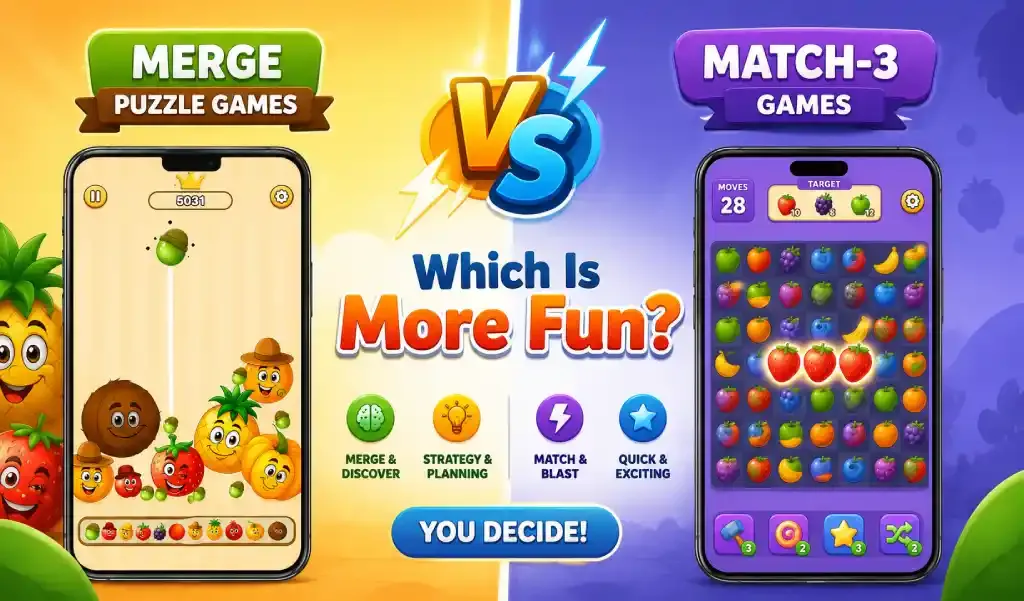
Match-3 games are fast, goal-driven and a little pressured: you swap tiles to line up three or more, clear levels and chase the next target. Merge puzzle games are slower and calmer: you combine matching pieces into bigger ones at your own pace, with no level to pass. Choose match-3 when you want a quick challenge with a clear finish line. Choose a merge game when you're tired, bored or want something that doesn't push back.
Open any app store's puzzle chart and you'll find two giant families side by side: match-3 and merge. They're often grouped together, and both are free to try and easy to start. But they ask for different moods. This guide compares them on the things that actually affect whether you'll enjoy them, including pace, pressure, session length, what the rewards feel like and what each demands from your head. We make a merge game (Fruit Fall: Match Puzzle Game), so we've tried to be fair to match-3, which is a very well-made genre.
The quick comparison
| Match-3 | Merge (physics drop style) | |
|---|---|---|
| Core action | Swap adjacent tiles to line up three or more | Drop pieces and merge identical ones into bigger ones |
| Board | Fixed grid | Open container, free placement |
| Structure | Levels with goals and limited moves | Endless, play until the container fills |
| Pressure | Medium to high | Low |
| Typical session | A level or several, often a few minutes each | Anything from two minutes to twenty |
| Main reward | Cascades, cleared boards, new levels | Bigger pieces, combos, a higher score |
| Best mood | Energetic, wanting a challenge | Tired, restless or wanting calm |
What makes match-3 fun
Match-3 works because it's fast and clear. You see a board, spot a move, make it and get immediate feedback: pieces vanish, new ones fall, and sometimes a chain reaction clears half the board. That quick cycle of effort and reward is deeply satisfying, and the structure of levels gives you a reason to keep going. The genre goes back to Bejeweled in the early 2000s, and Candy Crush Saga turned it into a mobile phenomenon in the 2010s.
The same design that makes it exciting can also make it feel like work. Limited moves, goals that must be completed, lives that run out, and boosters that appear just when you're stuck can turn a casual game into a chore. If you've ever replayed the same level a dozen times, you know the feeling.
What makes merge puzzle games fun
Merge games reward patience instead of speed. You combine similar pieces into bigger ones, and every merge both rewards you and opens space, which creates a calm loop that still needs thought. In the fruit style, you drop pieces into a container and work up a chain toward a melon or a coconut. There's no move counter and no level to fail, so a bad drop costs you space, not a retry.
The physics adds a quiet kind of interest. Round pieces roll and settle, so no two rounds play the same way. That unpredictability is the main thing that separates this branch of merge games from grid-based puzzles; our post on physics puzzles versus grid puzzles goes deeper into why it feels so different.
Which feels more relaxing?
For most people, merge games. Match-3 levels are pass-or-fail, and failing a level after a long attempt is a small disappointment. A merge game absorbs more of your mistakes: you can set your own pace, there's no timer, and a run ends when the container fills, not when you miss a target. You also don't need a high score to feel you've done something, because simply getting a bigger fruit than last time is enough.
That said, "relaxing" varies. Some people find match-3's clear goals soothing, because knowing exactly what to do is calming in itself. If open-ended play makes you feel adrift, a level-based game may suit you better.
Which is better for short breaks?
Merge games, generally. They're easy to start and easy to stop, since there's no goal you're halfway through. Match-3 levels ask you to finish something, which can stretch a "two-minute break" into twenty. Merge games fit well into:
- work and study breaks
- queues and waiting rooms
- commutes
- the last few minutes before bed
We look at the wider trend in the rise of short-session games, which explains why games that end cleanly have become so popular.
Which is more addictive?
Both can be, in different ways. Match-3 hooks you with level progression, boosters, maps to complete and the near-miss of a level you almost cleared. Merge games hook you with curiosity about the next bigger piece and the wish to keep the board clear. The first pulls you forward with goals, and the second pulls you along with small satisfactions. Neither is harmless if you lose track of time, so it helps to decide how long you'll play before you start.
What each asks of your brain
Match-3 builds pattern recognition and quick decisions. You scan for moves, compare options and sometimes plan a chain several swaps ahead. Merge games lean on spatial planning and patience: deciding where fruit will settle, keeping space open and judging when to merge now or wait. Neither is a proven brain-training tool. Studies of brain-training games have generally found that people get better at the game itself but not reliably at unrelated tasks, which we cover in our look at whether merge games are good for the brain.
A closer cousin you may be mixing up
If you're weighing number-based merging against object-based merging, that's a separate comparison. 2048-style games merge tiles on a fixed grid, which makes them far closer to match-3 in feel than to physics merge games. We cover that in merge games versus 2048.
Who should pick which
Pick match-3 if you want:
- fast action and colourful combos
- clear goals and levels to beat
- a harder challenge and the satisfaction of clearing it
Pick a merge game if you want:
- simple rules you can pick up in a minute
- no pressure and no failing a level
- short sessions with steady, visible progress
If you can't decide, think about how you feel right now. Wound up and wanting a challenge? Match-3. Tired or restless? Merge.
Why the two keep getting compared
There's a business reason as well as a gameplay one. Match-3 is still the bigger genre in mobile revenue, but merge has been the faster-growing subgenre, which is why the two are so often placed side by side. We dig into the numbers in how merge games quietly became match-3's biggest rival. It's useful context, though it says little about which one you'll enjoy more.
Frequently asked questions
Are merge puzzle games easier than match-3 games? Usually at the start, because the rules are simpler and there's less pressure. They still get harder as the container fills.
Are match-3 games better for brain training? They can sharpen pattern recognition and quick decisions. Merge games exercise planning and spatial thinking. Neither has been shown to improve unrelated mental skills.
Which is better for stress relief? Many people prefer merge games because they're slower, calmer and less competitive. If a goal-driven game soothes you, match-3 can do the same.
Are fruit merge puzzle games good for short sessions? Yes. You can play for a few minutes and stop whenever you like, with nothing left half-finished.
Do merge games have lives or timers? Fruit Fall: Match Puzzle Game doesn't: it's endless and ends only when the container fills. Other merge games may differ, so check the listing.
The bottom line
Match-3 is the better pick for a fast, goal-driven challenge. Merge games are the better pick when you want calm, flexible play and a break that ends when you say so. If you'd like to try the second kind, Fruit Fall: Match Puzzle Game is free on the App Store for iPhone and iPad.