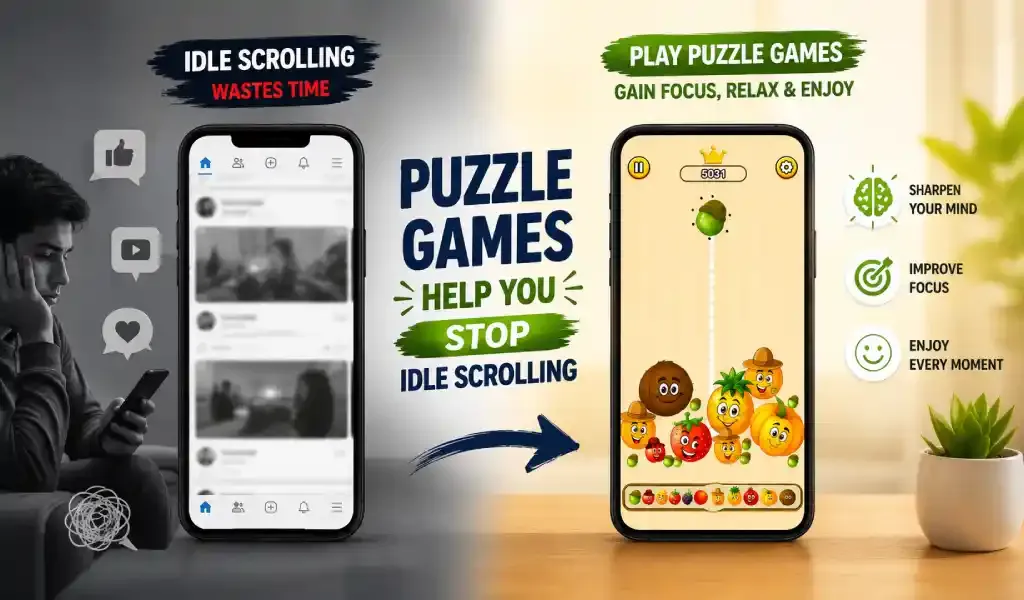
Idle scrolling is mostly a habit triggered by boredom, waiting and transitions, and it's hard to stop by willpower alone. A puzzle game can help as a replacement because a round has a clear ending, asks you to do something active, and gives you a result. It works best when you make the swap easy, set a time limit, and notice if the game becomes a new endless loop.
You pick up your phone to check one thing. Twenty minutes later you've seen a lot, remembered almost none of it, and feel a little drained. That's idle scrolling, and nearly everyone does it. The good news is that you don't need to quit your phone or delete everything. A small change in what you reach for often does more than a big resolution.
What idle scrolling actually is
Idle scrolling is using your phone with no particular goal, simply because it's there. It differs from looking something up or messaging a friend. There's no task to finish, so there's nothing to tell you when to stop.
Feeds make this easy. Infinite scroll removes the natural stopping points that a page, a chapter or an episode has. There's always another post just below the screen. That's a design choice, and it's not a personal failing if it pulls you in.
Why it leaves you feeling worse
Researchers who study social media and well-being often distinguish between active use, such as messaging, posting and commenting, and passive use, such as reading and scrolling. Passive use has been associated with feeling worse afterwards, and Facebook's own research team said as much in a December 2017 post about how people use the platform. It's a correlation, and it doesn't mean every scroll is harmful. But it matches what many of us notice: a conversation with a friend feels different from drifting through strangers' updates.
Part of the drained feeling is probably that your attention was pulled in a new direction every few seconds without ever settling. If low mood is part of the picture, why puzzle games can help with mental health covers what they can and can't do.
Why a puzzle game can be a good swap
Compared with a feed, a short puzzle game has four useful properties.
It has an ending. A round finishes when the container fills or the board locks. That's a built-in stopping cue the feed lacks.
It's active. You make decisions and see the result. You're doing something, not just receiving.
It's focused. One small problem at a time, with no stream of unrelated input.
It gives a result. A score, a bigger piece, a near miss. It's something concrete you can walk away from.
We explore why this matters for breaks in Rise of Short-Session Games for Quick Mental Breaks.
Know your triggers
Most scrolling happens at a handful of predictable moments:
- Waiting in a queue or for a lift
- First thing in the morning, or last thing at night
- Between tasks, especially after finishing something
- When you're avoiding something you don't want to do
- When you're a little anxious or low and want to numb out
Spend a day noticing which of these applies to you. Once you know your triggers, you can plan around them.
A seven-day swap that doesn't rely on willpower
Day 1: Notice. Don't change anything. Just make a mental note each time you scroll without purpose, and what triggered it.
Day 2: Pick one trigger. Choose the most common, such as the moment after lunch.
Day 3: Make the swap easy. Move your puzzle game to the first page of your home screen. Move the social apps into a folder on the last page. The better choice should be the one that takes the fewest taps.
Day 4: Write an "if-then" plan. Something like: "When I finish lunch, I'll play one round of my puzzle game." Specific plans work better than vague intentions.
Day 5: Add a time limit. Set a five-minute timer before you start. When it rings, you're done.
Day 6: Use the tools you already have. On iPhone, Screen Time lets you set App Limits for social apps (Settings → Screen Time → App Limits).
Day 7: Review. How did you feel after each swap? If you felt better, keep going. If you didn't, try a different replacement.
When the puzzle game becomes the new scroll
It can happen. A game with a strong "one more round" pull can turn into another way to lose an hour. Watch for these signs:
- You regularly play for much longer than you meant to.
- You're playing to avoid something, not to relax.
- You feel irritable or restless when you stop.
If that sounds familiar, shorten the timer, move the game off your home screen, or try a different replacement altogether.
Other swaps that work
A puzzle game isn't the only option, and it shouldn't be:
- A short walk, or even standing at a window
- Stretching or a few deep breaths
- Texting or calling a friend (active use, not passive)
- A page or two of a book
- A glass of water
The best replacement is whichever one you'll actually do. If a puzzle game is your pick, our checklist for a calming one helps you choose.
Make the game itself less sticky
- Play offline. No pop-ups or notifications mid-round.
- Pick a game without streaks or daily rewards. Those are designed to bring you back.
- Stop on a finished round. Ending on a completed round makes it easier to put the phone down.
- Keep it simple. Games with simple rules are easier to dip into and out of.
Frequently asked questions
Can puzzle games help you stop scrolling? They can help as a substitute, because a round has a clear ending and asks you to do something active. They won't fix the habit alone; making the alternative easy and the feed harder to reach does more.
Why is idle scrolling bad for me? It isn't harmful in small doses, but long stretches of passive scrolling are associated with feeling drained or worse, and with lost time.
What's the best replacement for doomscrolling? Anything with a clear ending that you enjoy: a short puzzle round, a walk, a call to a friend, or a few pages of a book.
How long does it take to change the habit? There's no fixed timetable. A week of deliberate swapping is a reasonable first experiment.
Should I delete my social apps? Only if you want to. Many people do better by making them less convenient, for example by moving them off the home screen or using Screen Time limits.
Is playing a puzzle game just replacing one screen with another? In a sense, yes. The difference is the ending and the activity. If screens are the real problem, a non-screen replacement is better.
The bottom line
You don't need to be perfect or give up your phone. Pick one trigger, make a better choice easier, and set a limit. A short puzzle round is one good option for that moment, as long as you stay honest about how it makes you feel.
We make Fruit Fall: Match Puzzle Game, a free drop-and-merge puzzle for iPhone and iPad that works offline. You can find it on the App Store.
Source: Ginsberg, D. & Burke, M. (2017). "Hard Questions: Is Spending Time on Social Media Bad for Us?" Facebook Newsroom. Coverage: Yourstory.