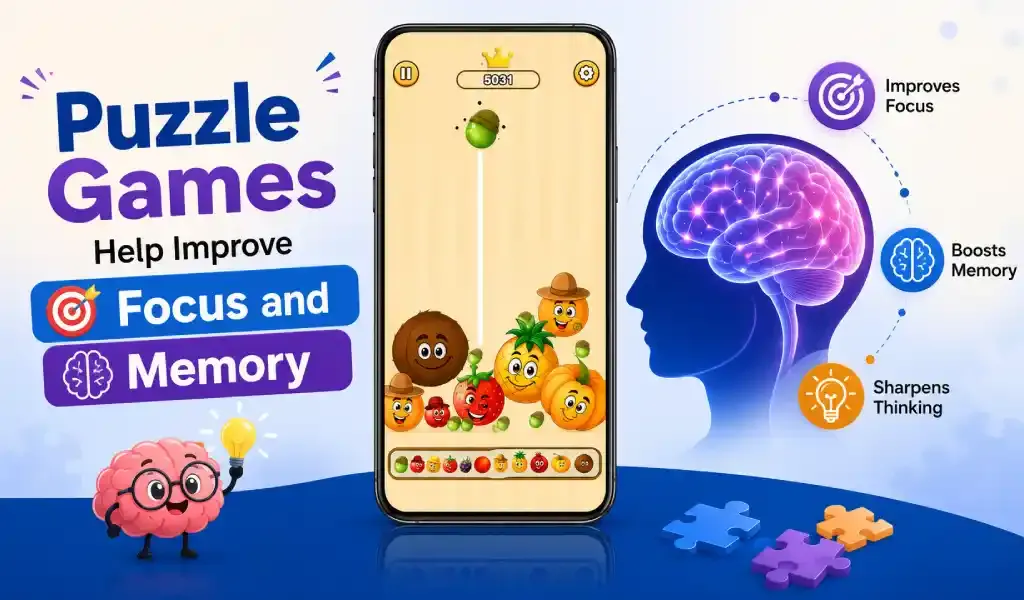
Puzzle games give your attention a single job for a few minutes, which is good practice for focus, and some puzzles also exercise short-term memory. The caveat is that research hasn't shown these gains reliably carry over to everyday life. Treat puzzles as a pleasant way to practise concentrating, choose games that actually lean on memory if that's your goal, and protect your focus from notifications while you play.
Two promises show up on almost every puzzle-game page: "sharpen your focus" and "boost your memory." Both are partly true and partly overstated. This post separates the two skills, shows which puzzles lean on each, and suggests a simple routine that makes the most of what puzzles can offer.
Focus: what puzzles actually ask of your attention
Attention isn't one thing. Psychologists talk about a few kinds, and puzzles touch two of them.
Sustained attention is staying with one task over time. A puzzle round that lasts several minutes asks for exactly this.
Selective attention is picking out what matters and ignoring the rest. In a busy board of fruit or tiles, you have to notice the useful pieces and filter out the clutter.
What puzzles generally don't ask for is divided attention, doing two things at once. That's a big part of why they feel restful. For ten minutes, there's one thing to look at.
That's the most defensible focus benefit: a clean stretch of single-tasking in a day that's otherwise full of switching. Whether it makes you better at concentrating on your job is not established. But it's real practice at staying with something, and it costs nothing. The same idea sits behind short-session games for quick mental breaks.
Memory: be specific about which kind
"Memory" covers several things, and puzzles exercise them very differently.
Working memory is what you hold in mind for a few seconds while you use it, like a phone number you're about to dial. Puzzles that ask you to keep several possibilities in your head at once, such as Sudoku or multi-step planning, lean on this.
Short-term memory for patterns is remembering what you've just seen. Card-matching games and sequence-repeat games exercise this directly.
Long-term memory is what you've stored over time. Crosswords and trivia-style puzzles draw on it, because you're retrieving words and facts you already know.
Now consider a drop-and-merge game like Fruit Fall: Match Puzzle Game. The whole board is visible all the time, so you aren't memorising anything. You learn the order of the fruit chain in a few rounds, and then you're reading the situation, not recalling it. It exercises judgment and spatial prediction far more than memory. We cover that further in how merge games affect the brain.
That's not a criticism, but it matters if memory is what you want. Games where information disappears, such as flipping cards or repeating sequences, are a better match for that goal.
What the research says about transfer
The big question with both focus and memory is whether getting better at a game helps you elsewhere. A 2016 review by Daniel Simons and colleagues in Psychological Science in the Public Interest looked at the evidence for commercial brain-training and found good evidence of improvement on the practised tasks but little convincing evidence of wider benefits. For a wider look at which skills different puzzles use, see our guide to improving brain functionality with puzzle games.
A sensible way to hold that: you'll probably get better at the game, and you'll probably enjoy the focused time. Anything beyond that is a bonus, not a promise.
A simple routine for getting more from puzzle time
Here's a routine that doesn't depend on any exaggerated claim.
- Play for ten to fifteen minutes. That's long enough to settle in and short enough not to tire you out. It's a practical suggestion, not a research-proven dose.
- Silence your phone first. Turn on Do Not Disturb or play in airplane mode. A single notification mid-round undoes the point of the exercise.
- Do only the puzzle. No podcast, no TV in the background. If you want to practise focus, give it your whole attention.
- Check in afterwards. Take 30 seconds to think about what you tried in the round. Did you plan, or just react? That small reflection helps what you did stick.
- Do it at a steady time. Practice tied to a daily moment, such as after lunch, is easier to keep up.
- Sleep properly. Memory is consolidated during sleep, and no puzzle makes up for too little of it.
Choosing a game for the skill you want
| If you want to practise... | Look for... |
|---|---|
| Sustained focus | Endless, no-timer puzzles you can sink into |
| Working memory | Sudoku, logic grids, multi-step planning puzzles |
| Pattern memory | Card-matching or sequence-repeat games |
| Recall from long-term memory | Crosswords, word and trivia puzzles |
| Spatial judgment | Physics and drop-and-merge games |
Protecting your focus while you play
A few small changes make a big difference:
- Put the phone on Do Not Disturb. Even the buzz of a notification pulls your attention.
- Play offline. No ads or pop-ups arrive when there's no connection.
- Sit comfortably with decent light. Strained eyes make it harder to concentrate.
- Stop when you're tired. Concentration drops, and playing on makes you sloppy and frustrated.
Frequently asked questions
Do puzzle games improve focus? They give you practice at sustaining attention on one task. Whether that carries over to work or study is not well established.
Do puzzle games improve memory? Some puzzles exercise memory directly, especially card-matching and sequence games. Games where everything is visible, like merge puzzles, use it very little.
How long should I play each day for focus? Ten to fifteen minutes is a reasonable starting point. There's no research-backed ideal duration.
What puzzle games are best for memory? Card-matching and sequence-repeat games, Sudoku, and crosswords all lean on memory more than physics or merge games do.
Can puzzle games help with ADHD or dementia? There's no reliable evidence that they treat or prevent either. If you have concerns about attention or memory, speak to a doctor.
Will playing in short sessions work? Yes. Short, regular sessions are easier to stick to and less tiring than long ones.
The bottom line
Puzzles are good practice at paying attention, and some are good exercise for short-term memory. They aren't a cure-all, and the claim that they sharpen your whole mind is stronger than the evidence. Pick a game that matches the skill you care about, switch off the notifications, and enjoy the quiet.
Fruit Fall: Match Puzzle Game, our free drop-and-merge puzzle for iPhone and iPad, leans more on focus than memory. You can find it on the App Store.
Source: Simons, D. J., et al. (2016). Psychological Science in the Public Interest. Coverage: Association for Psychological Science.