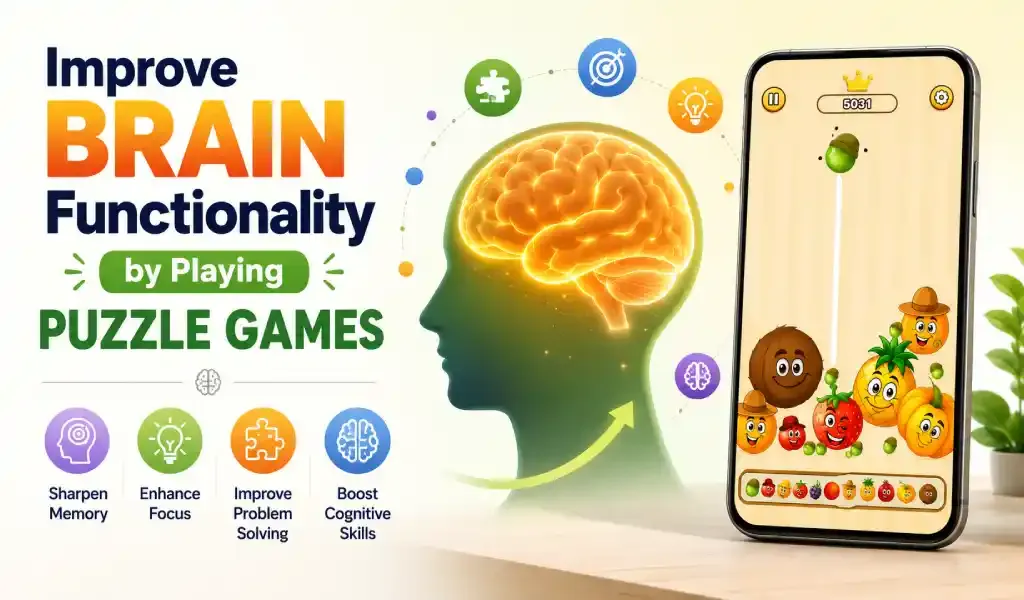
Puzzle games exercise real thinking skills, including attention, spatial reasoning, planning and flexibility, and practising them makes you better at those puzzles. What research hasn't shown convincingly is that this carries over into everyday life or raises general intelligence. The best way to get something out of puzzle games is to vary them, make them a little harder as you improve, and think about your mistakes afterwards.
"Brain training" is a big promise, and it's worth being straight about it from the start. Puzzle games do make you think. Whether they improve the way your brain works in general is less clear. This post breaks down which skills different puzzles actually exercise, what the research says, and how to play in a way that gives you the best chance of getting something useful out of it.
What the research says (briefly)
In 2016, psychologists led by Daniel Simons at the University of Illinois reviewed the evidence behind commercial brain-training programmes, in a report for the journal Psychological Science in the Public Interest. They found good evidence that people improve at the tasks they practise. They found little convincing evidence that those gains transfer to different tasks or to everyday cognitive performance.
In plain language: if you practise a puzzle, you get better at that puzzle and often at very similar ones. That's a real benefit. It's just a narrower one than the app-store marketing suggests.
None of this means puzzles are a waste of time. It means the sensible reasons to play them are enjoyment, a mental change of pace, and the satisfaction of improving, not a promise to raise your IQ.
Which skills different puzzles exercise
Different puzzles lean on different mental muscles. Knowing which is which helps you choose.
Spatial reasoning. Games where you judge shape, position and movement, such as fitting pieces together or predicting where a falling object will land, use this. Drop-and-merge games are a good example: you're estimating where a round fruit will roll and settle.
Planning and working ahead. Chess-like or grid puzzles ask you to hold a few possible moves in mind and compare them. The more steps ahead you look, the more it's a planning exercise.
Pattern recognition. Match games and sequence puzzles reward you for spotting repeated structures quickly. With practice, this becomes almost automatic.
Cognitive flexibility. Trick puzzles and riddles make you drop an assumption and try another approach. They're good for noticing when you're stuck in one way of thinking.
Attention. Almost every puzzle asks you to concentrate on one thing for a while. That's a skill in itself in a world of constant interruption. (We look at attention and memory in more detail in our guide to puzzles, focus and memory.)
Processing speed. Timed games push you to decide quickly. Be careful here: speed under pressure can make some players stressed rather than sharper.
Why variety matters
If you always play the same puzzle, you'll get very good at that one puzzle and stop being challenged. Rotating between physics games, grid games and riddles keeps you using different skills, and it keeps things interesting.
We explain how two of those families differ in Merge Games vs. 2048 and Merge Puzzle Games vs Match-3 Games, which is a useful way to pick your next game.
How to practise in a way that actually helps
There's no proven formula, but these habits fit what we know about learning:
- Keep it a little hard. A puzzle that's too easy is just a pastime. One that's a bit too hard is frustrating. Aim for the zone where you win about as often as you lose.
- Reflect on your losses. After a bad round, ask what went wrong. Was it a rushed move? A plan that didn't account for something? Naming the mistake is where the learning is.
- Slow down on purpose. Try one round where you take twice as long on every move. You'll often find you were making avoidable errors.
- Change the constraint. Set yourself a rule, like always starting in a corner, and see how it changes your play.
- Keep sessions short. Ten to twenty minutes is enough. Long sessions bring fatigue, and tired players make sloppy moves.
- Don't treat it as medicine. If you enjoy it, play. If it stops being fun, stop.
What puzzle games can't do
- They can't replace sleep, exercise or social contact, which have much stronger evidence for supporting brain health.
- They can't prevent or treat dementia or other medical conditions. If you're worried about memory or thinking, talk to a doctor.
- They can't make you smarter in general, as far as the best evidence shows.
A realistic way to think about it
A good puzzle game is like a good crossword or a walk: a pleasant activity that engages you and leaves you in a better frame of mind, with perhaps some small skill gains in the thing itself. That's a perfectly good reason to do it.
Frequently asked questions
Do puzzle games improve brain function? They improve your performance on the puzzles you practise. Large reviews find little evidence that this transfers to general intelligence or everyday thinking.
What skills do puzzle games train? Depending on the game: spatial reasoning, planning, pattern recognition, flexibility, attention and speed.
How often should I play puzzle games? Short, regular sessions of ten to twenty minutes work well for most people. There's no research-backed ideal number.
Which puzzle games are best for the brain? The best one is the one that challenges you without frustrating you, and that you'll keep playing. Mixing different types is better than sticking to one.
Can puzzle games prevent dementia? There's no reliable evidence that they can. Exercise, sleep, social connection and medical care matter much more. If you're concerned, see a doctor.
Are merge puzzle games good for the brain? They exercise spatial judgement and planning. We cover them specifically in Are Merge Puzzle Games Good for Brain?.
The bottom line
Play puzzle games because they're enjoyable and they give you a good mental change of pace. Treat any promise of dramatic brain-boosting with caution, vary the games you play, and learn from your mistakes. That's about as much as the evidence supports, and it's plenty.
We make Fruit Fall: Match Puzzle Game, a free drop-and-merge puzzle for iPhone and iPad, so we're not neutral. You can find it on the App Store.
Source: Simons, D. J., et al. (2016). "Do 'Brain-Training' Programs Work?" Psychological Science in the Public Interest. Coverage: Association for Psychological Science and University of Illinois.