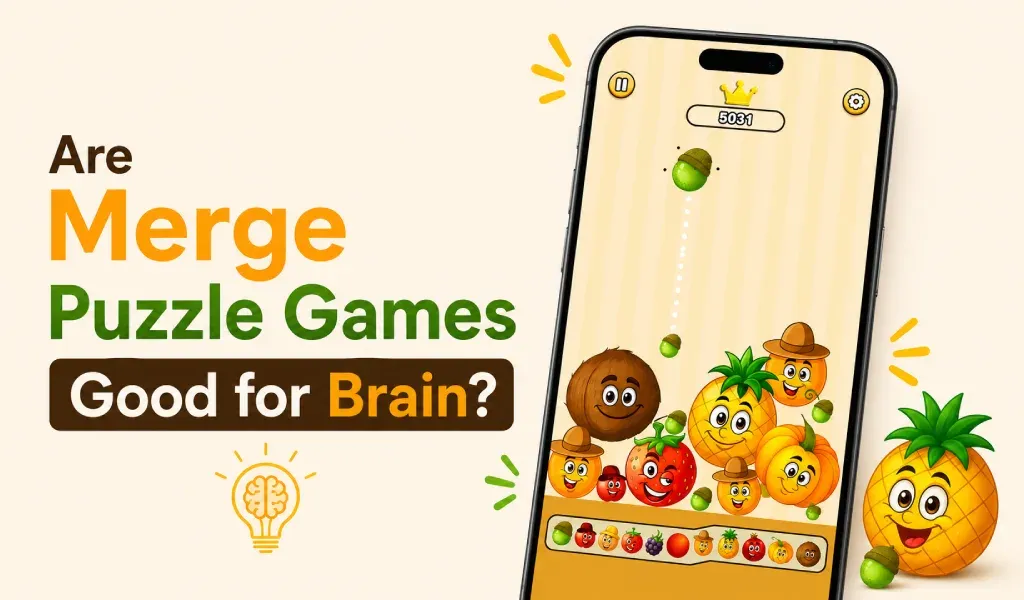
Merge puzzle games are decent exercise for spatial judgment, planning a move or two ahead, and staying calm after a bad round. They aren't a clinical brain-training tool, and they use memory very little, because the whole board is on screen. Played in short sessions, they're a good way to give your mind something to do. Played for hours, they can leave you tired, and the free versions often come with ads.
Merge puzzles, the drop-and-match games where identical pieces combine into bigger ones, are everywhere on phones. Players often describe them as "good for the brain." Is that fair? Here's what these games really ask of you, what they don't, and how to play them sensibly.
What a merge game is
In a typical merge puzzle, you drop pieces into a container. When two identical pieces touch, they combine into the next piece in a chain. In fruit versions like Fruit Fall: Match Puzzle Game, small fruits merge into larger ones, up to a big coconut at the top of the chain. The round ends when the pile rises over the top.
Because the pieces roll and settle, no two rounds play out exactly the same. That unpredictability is a big part of what makes them engaging, and a big part of what they ask of your brain.
What merge games ask of your brain
Spatial prediction
Each drop is a small physics forecast. Where will this round fruit land, what will it bump into, and where will it settle? You're estimating, not calculating, and you get better with practice. It's the same kind of judgment you use to guess where a ball will bounce.
Planning a move or two ahead
Good players don't only think about the current fruit. They think about what the merge will set up next. A drop that creates a second merge is worth more than one that just completes the first. That's a light, forgiving form of planning.
Pattern recognition
You quickly learn to spot useful arrangements, such as two matching fruits nestled in a corner, and risky ones, such as a big fruit stuck in the middle. With practice, you stop thinking about it and see it at a glance.
Impulse control
The temptation is to drop quickly. The skill is waiting. Many players find that simply slowing down improves their results more than any strategy.
Staying steady after a loss
Because a bad bounce can ruin a promising round, the game gives you regular practice at shrugging off a setback and starting again. That sounds trivial, but it's the main reason people describe these games as relaxing rather than stressful.
What merge games don't do much
It's worth being honest here.
- Memory. The board is fully visible, so there's very little to remember beyond the order of the fruit chain.
- Language and maths. No words or numbers to work with.
- General intelligence. Reviews of brain-training research, including a major 2016 review led by Daniel Simons, found little evidence that practising a game makes you smarter in general.
So the fair summary is that merge games exercise a narrow, useful set of skills in a pleasant way, but they're not a workout for the whole brain. We break down which thinking skills different puzzles exercise in a separate guide.
The calming side
A lot of people play merge games to unwind. A few features help:
- No timer. Nothing is chasing you.
- Short rounds. A round is over in minutes, so there's always a natural place to stop.
- Soft feedback. Satisfying merge animations and sounds make small wins feel good.
- Low stakes. A lost round costs you nothing but a few minutes.
Small studies of casual games have found improvements in mood after playing, though the evidence is limited. We discuss that in more detail in Why Are Puzzle Games Good for Mental Health?.
The downsides
- Fatigue. Long sessions tire your eyes and your concentration. Tired players make careless drops and get frustrated.
- "One more round." The quick restart makes it easy to keep going. A timer helps.
- Ads. Free games usually include them. A full-screen ad between rounds can undo the calm.
- Late-night play. Bright screens close to bedtime can interfere with sleep.
Getting the most out of them
- Keep sessions short. Ten to twenty minutes is plenty.
- Slow down. Deliberately take longer over each drop for one round and see what changes.
- Look one step ahead. Before releasing a fruit, ask what it will touch.
- Set a rule. For example, always build in the left corner. Rules make you think about what you'd normally do automatically.
- Take breaks. Stand up, look out of a window, and come back.
- Rotate games. Mix merge puzzles with grid or word puzzles for variety. We compare styles in Merge Games vs. 2048.
Who might enjoy merge games most
People who like physical, hands-on puzzles tend to take to them. If you prefer deterministic puzzles where you can work out the right answer, you might find the physics frustrating. Neither reaction is wrong.
Frequently asked questions
Are merge puzzle games good for your brain? They give good practice in spatial judgment, light planning and staying calm after setbacks. They don't exercise memory much, and there's no solid evidence they raise general intelligence.
Do merge games improve problem-solving? They practise a specific kind: managing limited space and thinking one or two moves ahead. Whether it carries over to other problems isn't established.
Are merge games relaxing? For most people, yes, because they have no timer, short rounds and low stakes. Ads and long sessions can spoil that.
How long should I play merge games? Ten to twenty minutes at a time is a sensible limit. Stop if you're tired or frustrated.
Are merge games better than match-3 games? Neither is better. They're different: merge games rely on physics and estimation, match-3 games on fixed grids and pattern spotting. We compare them in Merge Puzzle Games vs Match-3 Games.
Are merge games good for kids? Many are simple enough for young children, but check for ads and in-app purchases and set limits on screen time.
The bottom line
Merge games are good for what they are: a calm, absorbing way to practise judging space and thinking a step ahead. Don't expect a transformation. Do expect a pleasant ten minutes.
Full disclosure: Fruit Fall: Match Puzzle Game is ours, a free merge puzzle for iPhone and iPad. If you'd like to see how these ideas feel in practice, it's on the App Store.
Source: Simons, D. J., et al. (2016). Psychological Science in the Public Interest. Coverage: University of Illinois.