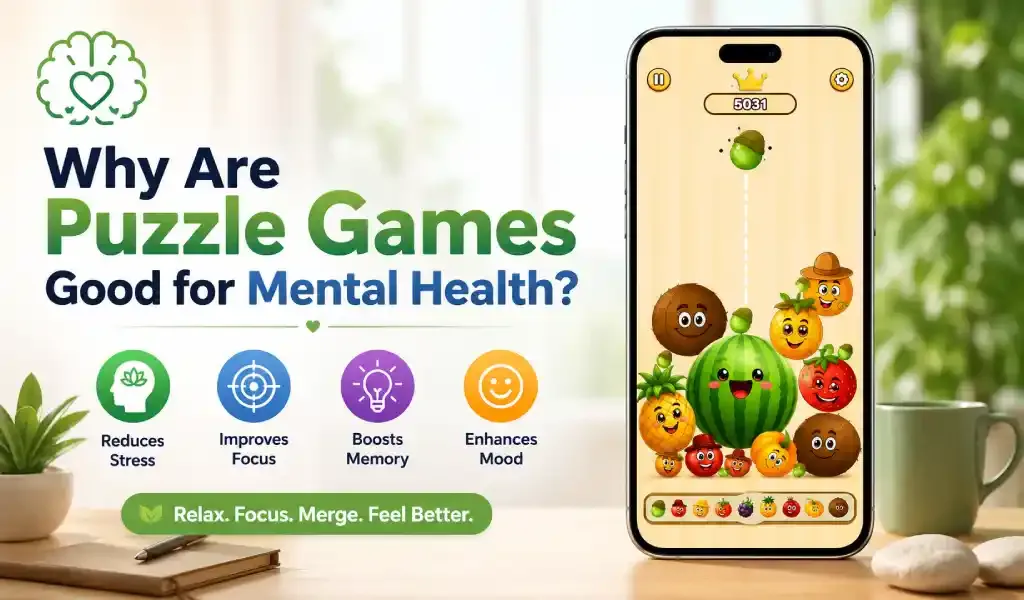
Puzzle games can help you feel calmer for a while because they absorb your attention, give you clear rules and a sense of control, and reward you with small wins. Small studies of casual games have found improved mood afterwards. They aren't a treatment for anxiety, depression or any other condition, and they work best as one gentle habit among others.
When life feels crowded, a puzzle game is a small, low-effort way to step out of it for ten minutes. That can really help. This post looks at why, what the research actually supports, and where the limits are.
Why puzzles can feel calming
They absorb your attention
Puzzles give your mind a single, manageable job. When you're working out where a piece should go, there's less room in your head for the things that were worrying you. Psychologists use the word "flow" for the state of being fully absorbed in something at the right level of challenge, and puzzles are a common way into it. Not every session reaches that state, but when it happens, time seems to pass easily. (If you're curious about the attention side, what puzzles do for focus and memory goes deeper.)
They offer control
Much of what stresses us is out of our hands. A puzzle game has clear rules, and what you do has a visible effect. That predictability can feel like a relief, especially on days when everything else is uncertain.
They deliver small wins
Clearing a level, creating a bigger piece, or beating your best score gives you a small, quick sense of achievement. These tiny rewards add up, particularly on days when bigger goals feel slow.
They're gentle on the mind
Simple puzzles with slow pacing and no timer tend to feel soothing. Fast, noisy, high-pressure games do the opposite. If calm is what you want, choose accordingly.
What the research suggests
Two studies are often cited, and both are worth reading with caution.
A study from East Carolina University, led by Carmen Russoniello, looked at casual video games and found that playing was associated with improved mood and lower stress, measured with heart-rate and brain-activity readings. It was small and short-term, so it's an encouraging sign, not proof of lasting benefit.
A 2009 experiment at Oxford, led by Emily Holmes, found that people who played Tetris soon after watching a distressing film reported fewer intrusive memories of it over the following week. That was a lab study with a film, not real-life trauma, and nobody should read it as evidence that a game treats post-traumatic stress.
Put together, these studies point in a modest direction: absorbing, low-pressure games can help shift your mood for a time. They don't show that puzzle games treat mental health conditions. For what puzzle games do and don't do for your thinking, see whether merge games are good for the brain.
How to make puzzle games part of looking after yourself
- Use them as a pause, not an escape hatch. Ten minutes after a stressful meeting is a healthy use. Hours of avoiding a problem is not.
- Pick the right kind of game. Look for no timer, simple controls, short rounds and calm sound. We list the features that matter in Best Puzzle Game for Stress Relief in 2026.
- Keep sessions short. Ten to twenty minutes is enough for a mood shift.
- Protect your sleep. Avoid playing right before bed, and keep late sessions short.
- Combine it with other habits. A walk, a chat with a friend, and enough sleep have much stronger evidence behind them than any game.
- Notice how you feel. If a game leaves you irritable or wired, it isn't doing its job.
A simple ten-minute reset
If you'd like a concrete way to use a puzzle game as a break, this works for many people:
- Stop what you're doing and put the task down. Even a minute of leaving the screen you were on helps.
- Take a few slow breaths before you open the game.
- Play for ten minutes with a timer set, so you don't have to watch the clock.
- When it rings, finish the round and stop. Ending on your own terms is part of the benefit.
- Ask yourself how you feel. If you're calmer, good. If you're not, try something else, such as a short walk or a glass of water.
It's not a treatment, just a small routine, and you can adjust it to fit your day.
When a game isn't enough
Puzzle games are not a substitute for professional help. Consider talking to a doctor or mental health professional if you notice:
- Low mood or anxiety that lasts more than a couple of weeks.
- Trouble sleeping, eating or functioning at work or home.
- Using games to avoid people, responsibilities or feelings for long stretches.
- Thoughts of harming yourself.
It's perfectly fine to enjoy a game and also get proper support. The two aren't in competition.
The downsides
- Avoidance. A game can postpone a problem, but it can't solve it.
- Frustration. Games that are too hard or too competitive can raise stress.
- Ads. Pop-ups between rounds can break the calm.
- Screen time. Too much of it, especially at night, can cut into rest.
Frequently asked questions
Are puzzle games good for mental health? They can help you relax and feel better for a while. Small studies support short-term mood benefits, but they're not a treatment for any mental health condition.
Can puzzle games reduce anxiety? They may help you feel calmer in the moment by taking your mind off worries. They won't treat an anxiety disorder, and persistent anxiety deserves professional support.
What kind of puzzle game is best for relaxing? Games with no timer, simple rules, soft visuals and sound, and short rounds. Drop-and-merge games and gentle match games often fit.
How long should I play to feel better? There's no proven number. Ten to twenty minutes is a sensible starting point.
Can puzzle games help with depression? There's no reliable evidence that they treat depression. If you're struggling with low mood, please speak to a doctor or a mental health professional.
Is it unhealthy to play puzzle games every day? Not for most adults, as long as it doesn't take over your sleep, work or relationships. If it does, cut back.
The bottom line
A puzzle game is a small tool: a few quiet minutes, a bit of absorption, a handful of easy wins. Used that way, it's a kind thing to do for yourself. It won't fix a hard time, and it isn't meant to.
We make Fruit Fall: Match Puzzle Game, a free, offline-friendly drop-and-merge puzzle for iPhone and iPad. You can find it on the App Store.
Sources: Russoniello, C. V., O'Brien, K., & Parks, J. M. (2009). Coverage: East Carolina University. Holmes, E. A., et al. (2009). PLoS ONE. Oxford University Research Archive.