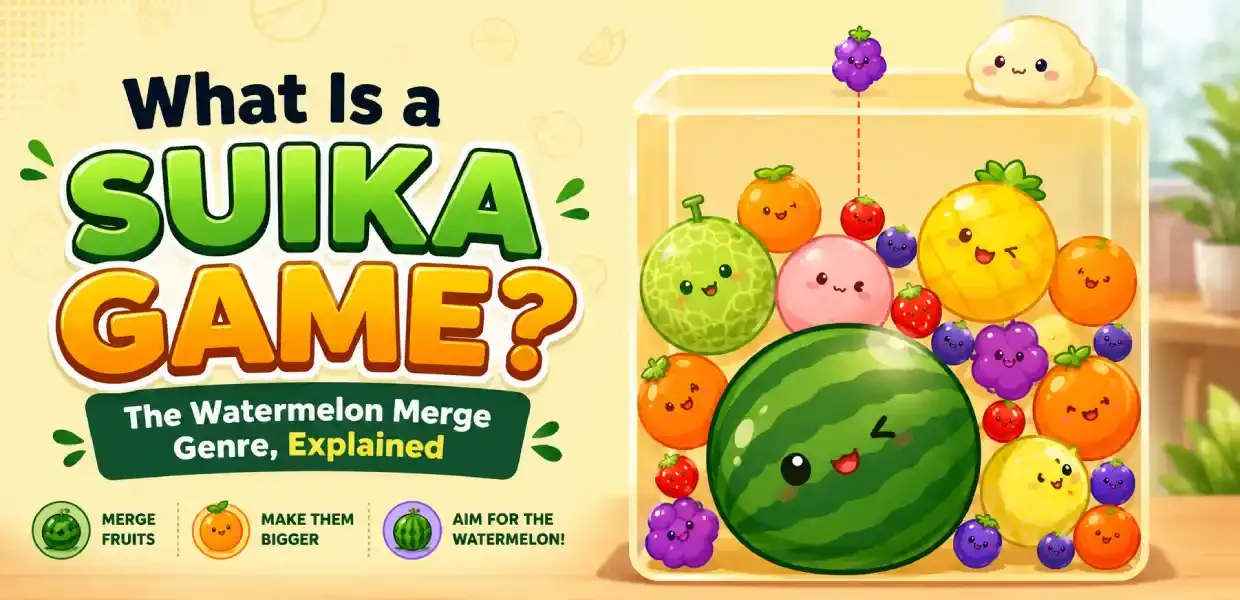
A Suika game is a physics-based puzzle where you drop fruit into a container and merge two matching fruits into the next size up, working along a fixed chain until you make a giant watermelon, all before the pile overflows. "Suika" is the Japanese word for watermelon. The name comes from Suika Game, the 2021 Japanese release from developer Aladdin X that turned a niche idea into a worldwide genre.
If you've watched someone drop cartoon fruit into a box and wondered why it looks so absorbing, this guide is for you. It covers where the name comes from, how the genre started, how a round works, why it spread so quickly, and how it differs from other "merge" puzzles. We make a game in this genre ourselves (Fruit Fall: Match Puzzle Game), so we'll flag that where it matters.
Where the name "Suika" comes from
"Suika" (スイカ) is simply the Japanese word for watermelon. The name stuck because the best possible outcome of a round is two watermelons colliding and vanishing, and the watermelon is the biggest fruit in the chain. When the genre spread beyond Japan, English-speaking players kept the Japanese name rather than translating it, so you'll see the same kind of game called "Suika Game," "the watermelon game," or "the melon game," depending on where you first came across it.
One small point worth knowing: "Suika Game" is the title of a specific game owned by a specific company. "Suika-style" or "watermelon merge" describes the mechanic more broadly. That's the sense we use in the rest of this post.
How the genre started
The drop-and-merge idea didn't begin with the name. A Chinese browser game called Merge Big Watermelon introduced the same basic mechanic in January 2021. Later that year, the Japanese company Aladdin X built its own version, first for its line of digital projectors and then for the Nintendo eShop in Japan in December 2021, under the title Suika Game.
For almost two years it stayed a modest Japanese release. Then, in 2023, Japanese streamers and VTubers started playing it on camera. The mix of simple rules and constant near-misses made it as fun to watch as to play, and the game took off. By November 2023 it had passed four million downloads and was reported as the best-selling eShop title on Switch in Japan that year. Aladdin X followed with a worldwide Switch release in October 2023, then versions for phones through 2024, and has since reported more than 13 million downloads worldwide. A sequel, Suika Game Planet, launched in Japan in December 2025 and reached the US in January 2026, so the genre is still being developed rather than fading out.
How a round works
The rules are nearly identical across the genre:
- A fruit appears at the top of the screen.
- You move it left or right, then let go to drop it.
- When two identical fruits touch, they merge into the next fruit up the chain.
- Bigger fruits are worth more points.
- The round ends when the pile rises above the top line of the container.
In the original, the chain runs from small, common fruit to large, rare fruit: cherry, strawberry, grape, dekopon (a Japanese citrus), persimmon, apple, pear, peach, pineapple, melon and watermelon. Other games change the fruit or the number of steps. Fruit Fall, for example, ends in a coconut. The shape is always the same, though: lots of small pieces at the bottom, a few big ones at the top.
The skill isn't in the dropping. It's in the deciding. One careless placement can wall off space you'll need for a merge several fruits later, and since the pieces are round, they don't stay where you put them.
Why it spread so quickly
Several things lined up:
- The rules take ten seconds to learn. Watching one round explains the whole game, so there's no tutorial to get through.
- The physics gives every board its own character. Fruit rolls and settles unpredictably, so identical moves rarely produce identical results. That's also the central idea in physics puzzles versus grid puzzles, which explains why this kind of game feels so different from Tetris or match-3.
- It's built for spectating. A stack creeping toward the line creates real tension on screen, which is part of why streamers helped it break out.
- Sessions stretch to fit. A round can end in two minutes or run past twenty, so it suits almost any gap in your day.
That combination of instantly understandable, hard to master and satisfying to watch is the formula behind most breakout mobile puzzle hits.
Suika-style games vs. other puzzle genres
These genres get lumped together because they all involve "combining" something, but the mechanics are quite different:
- Match-3 games (Candy Crush, for example) ask you to swap adjacent tiles on a grid so that three or more of the same kind line up and clear. There's no real physics. We compare the two styles in merge puzzle games vs. match-3 games.
- 2048-style games merge numbered tiles on a fixed grid using swipes. The sliding-tile cousin of the fruit games is covered in merge games vs. 2048.
- Suika-style games use continuous physics and free placement rather than a grid, and merge along a fixed chain instead of matching three in a row.
Put simply: match-3 is pattern matching on a grid, 2048 is arithmetic on a grid, and Suika-style games are spatial planning inside a physics simulation. They are genuinely different genres that happen to share the word "merge."
A short glossary
If you're new, a few terms come up constantly:
- Chain: the fixed order of fruits, from smallest to largest.
- Overflow line: the line at the top of the container. A fruit that rests above it ends the round.
- Combo: one merge that causes another, such as a new fruit landing next to a matching one. Chaining these is how high scores happen.
- Clone: an unofficial game that copies the mechanic, usually with different art and names.
- Booster: a special item, found in some versions, that clears or reshuffles pieces.
Is every watermelon merge game "Suika Game"?
No. Suika Game is a specific title owned by Aladdin X. The mechanic itself is simple to rebuild, so many independent developers have released their own drop-and-merge games with different fruit, art and names. That's also why most "play Suika Game online" results are unofficial browser clones rather than the original.
Our own game, Fruit Fall: Match Puzzle Game (earlier called Fruit Merge Melon Puzzle), is one of those independent takes. It's a free iPhone and iPad game built around short, low-pressure sessions, not the original and not affiliated with Aladdin X. If you're deciding which to try, our comparison of the original and our game lays out the differences honestly.
What to look for in a first game
If you're about to try the genre, a good first experience usually has these features:
- Believable physics, where fruit rolls and bumps the way you'd expect.
- A clear overflow line so you always know how close you are to losing.
- No timer, so you can think before you drop.
- A fair number of ads (or a way to avoid them), since a full-screen ad after every round spoils the calm.
- A recent update history, which suggests the game still works on current devices.
Frequently asked questions
Is Suika Game free to play? The official Suika Game is a paid title on the platforms where it's sold. Most free versions you'll find online are unofficial clones of the genre, not the original.
What's the biggest fruit in a Suika game? It varies by version, but most games end their chain with a watermelon, which is where the genre's name comes from. Some, like Fruit Fall, end with a different large fruit.
Is a Suika game the same as 2048? No. 2048 merges numbered tiles on a fixed grid using swipes. Suika-style games drop physical objects into an open container with no grid and real physics.
What's the best strategy for a Suika-style game? Keep your biggest fruits together in one corner, leave the middle clear, drop beside a matching fruit rather than near it, and plan two or three drops ahead instead of reacting only to the current fruit.
Can I play a Suika-style game on my phone? Yes. The original is sold on mobile, and independent developers have built their own versions. Ours, Fruit Fall: Match Puzzle Game, is free on iPhone and iPad.
Is it a good game for short breaks? Yes. There's no level to finish and no timer, so you can stop whenever you like. Our post on the rise of short-session games explains why that format has become so popular.
The bottom line
A Suika game is a small idea that works unusually well: drop, merge, repeat, and try not to run out of room. The original made the genre famous, and plenty of studios have built their own takes since. If you'd like to try one for free, Fruit Fall: Match Puzzle Game is on the App Store for iPhone and iPad.